On a corner pivot, a constant-rate injection pump puts about a third less chemical on the corners than on the rest of the field. AgriNET Proportional Chemical Injection paces the injection pump to the pivot’s flowmeter, second by second, so every acre gets the label rate whether the swing arm is in or out.
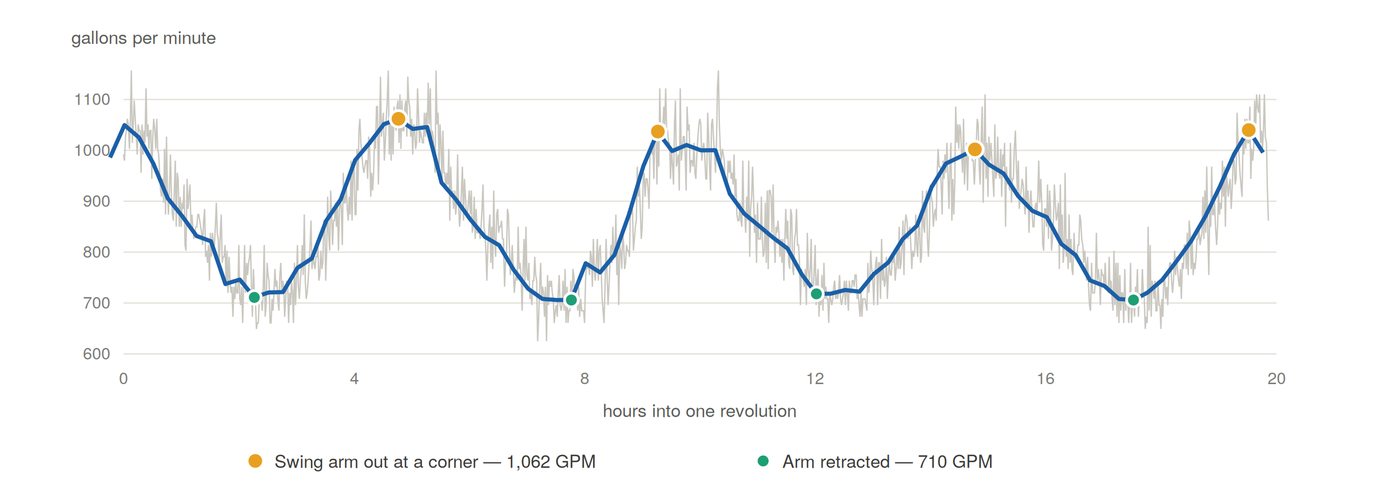
When the swing arm reaches out into a corner, the pivot starts covering about 1.5 times more ground every minute, and the water flow rises with it. A fixed-rate injection pump has no way to know. It keeps sending the same amount of chemical per minute, so the corners get a lighter dose on every pass, every season.
The usual workaround is to turn the pump up until the corners get enough. Then every acre between the corners gets about 1.5 times the label rate.
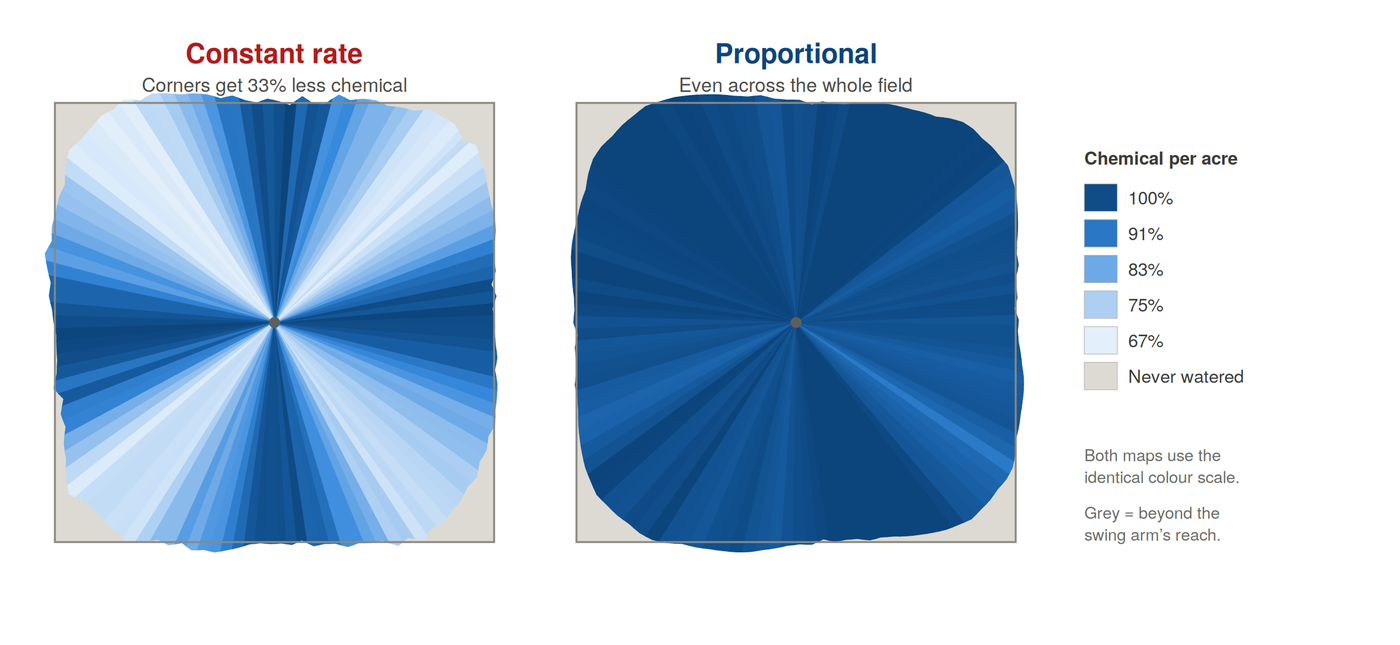
Chemical per acre on a working corner pivot, constant-rate injection (left) versus proportional injection (right). Built from 1,174 flowmeter readings, one every minute, across one 20-hour revolution. Data: Skone Irrigation.
33%less chemical in the corners at a constant injection rate
50%more chemical between the corners than in them
0%rate error once injection is paced to the flowmeter
Water flow over one revolution of the same pivot: about 710 GPM with the swing arm retracted and about 1,062 GPM with the arm out at a corner. Four peaks, one for each corner.
How it works
The flowmeter on the pivot measures the water flow continuously.
You set the chemical rate in gallons per hour for the machine at full flow.
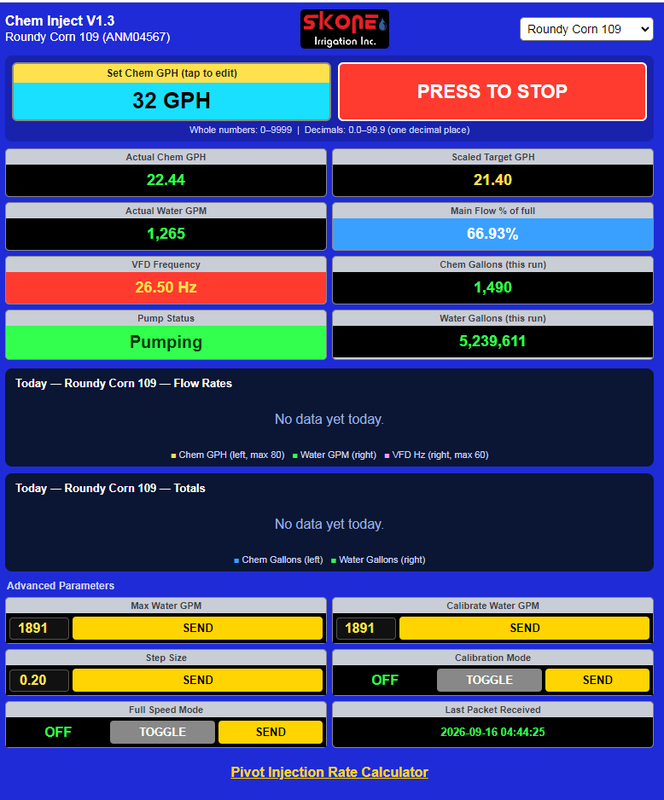
The controller scales that rate to the actual flow. At 67% of full flow, for example, a 32 GPH setting becomes a 21.4 GPH target.
A variable frequency drive (VFD) runs the injection pump, and a PID control loop adjusts its speed until the actual chemical rate matches the target.
Chemical and water gallons are totaled for every run, giving you an application record backed by the meter log.
Equipment
Works with any 480 VAC injection pump.
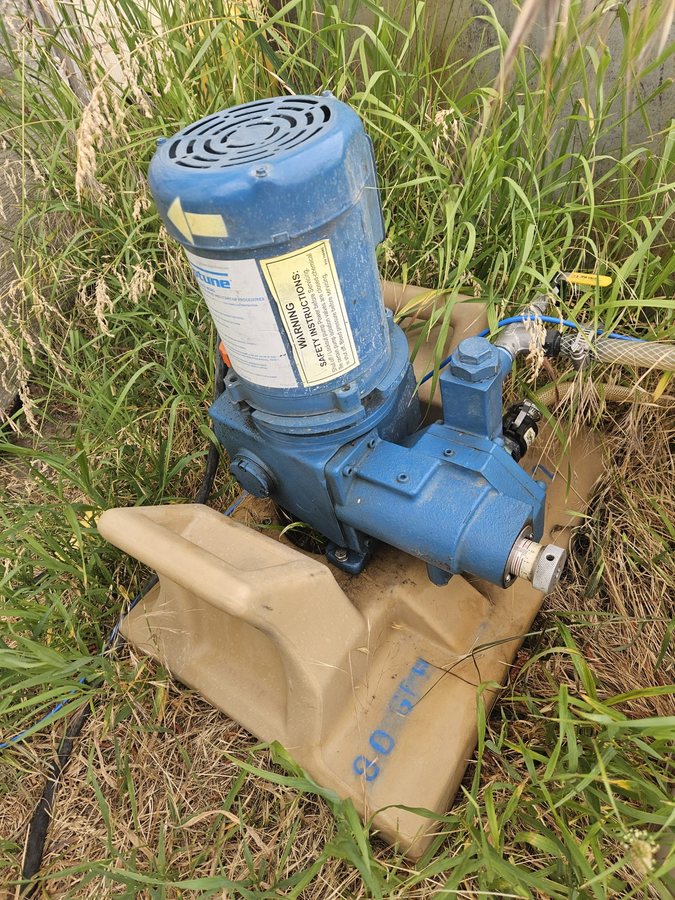
Our standard metering pump delivers 5 to 80 GPH.
Handles any chemical used in agriculture: fungicides, insecticides, herbicides and fertilizers such as UAN.
Built for corner machines and retrofits to the pivot you already own.
Control at the panel
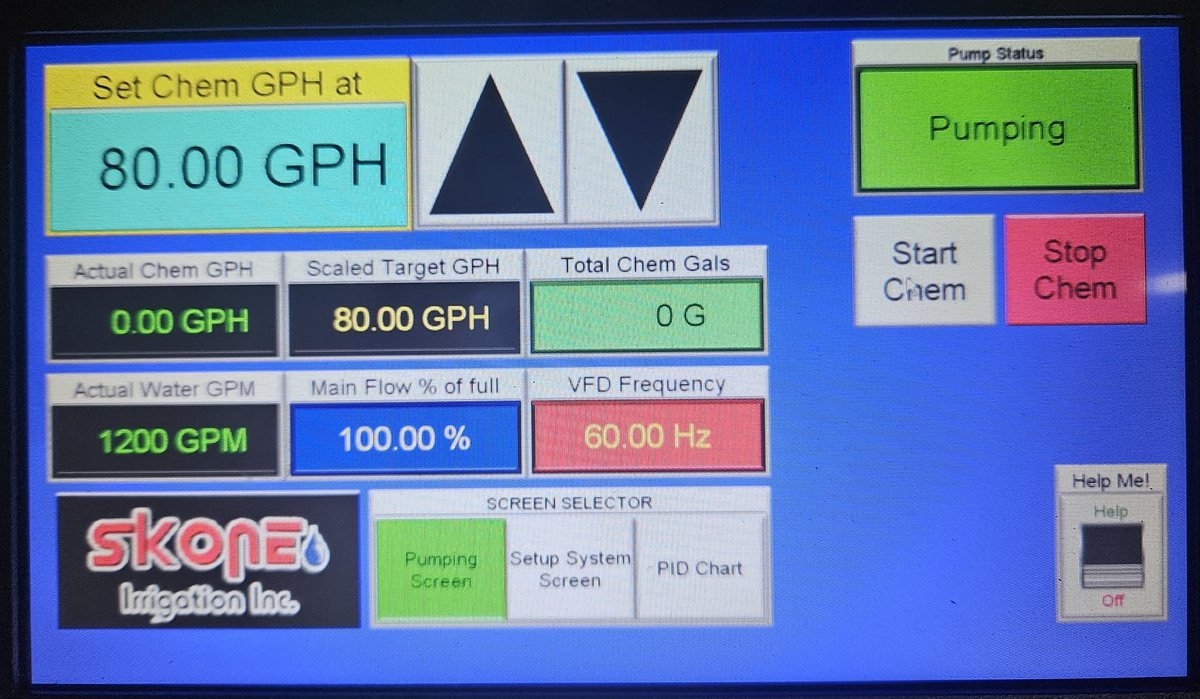
The touch screen on the injection system shows everything at a glance:
Set the chemical rate with up and down buttons, and start or stop injection.
Live actual chemical GPH, scaled target GPH, water GPM and main flow as a percent of full.
VFD frequency, pump status and total chemical gallons.
Setup screen and a PID chart for tuning.
Monitor and control from your phone
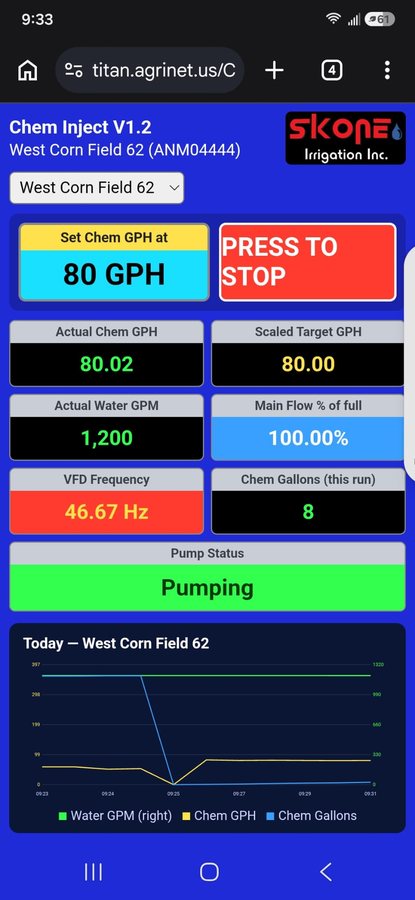
Every injection system has its own AgriNET web page that works on any phone, tablet or computer:
Change the chemical rate or stop injection from anywhere.
Live chemical GPH, water GPM, VFD frequency and pump status.
Chemical and water gallons for the current run.
Charts of today’s flow rates and totals.
Calibration settings: maximum water GPM, step size, calibration mode and full speed mode.
A built-in pivot injection rate calculator.
The same page on a computer, with daily charts and the calibration settings.
What it saves
When the pump is turned up to give the corners a full rate, the whole circle receives about 124% of what it needs. About 19.5% of every gallon of chemical lands on ground that was already covered. Proportional injection stops paying for it.
Program, 152 wetted acres
Cost per acre
Constant rate, per pass
Proportional, per pass
Saved per season
Chlorothalonil (Bravo WS), 1.5 pt/A, 8 passes
$8.25
$1,557
$1,253
$2,427
Mid-priced fungicide, 8 passes
$20.00
$3,776
$3,040
$5,885
Premium fungicide, 8 passes
$35.00
$6,607
$5,320
$10,300
UAN 32-0-0 at 40 lb N/acre, 4 passes
$28.82
$5,439
$4,380
$4,239
Example from Skone Irrigation’s analysis of one corner pivot. Fertilizer pricing from the DTN retail survey, July 2026 (UAN32 at $461/ton); chlorothalonil from published retail list pricing. Your savings depend on your acres, rates and prices.
Fungicide programs gain the most, because they run eight to twelve passes a season. A corner that runs a third light on a protectant is also where disease starts and where resistance gets selected for.
Sold exclusively through Skone Irrigation
The AgriNET Proportional Chemical Injection system is sold and installed exclusively by Skone Irrigation Inc. Ask Skone to log one revolution of your pivot, map your field and show you what your corners are actually getting.